
Flexible relocation programs are the most talked-about idea in global mobility right now. Core-flex, points-based menus, managed lump sums, choice architecture. Every RMC has a version, and the good ones work: the employee gets what they need, the company stops paying for benefits nobody uses, and the services that matter most stay in a core that nobody can trade away.
Look at what sits in that core. Immigration has a law firm and a compliance standard. Tax has a provider and a filing calendar. Temporary housing has an approved inventory. The household goods shipment has a mover, a survey and transit insurance. Each of these is funded, supplied and held to a standard, because the consequences of getting them wrong are serious and the family cannot judge the risk on their own.
Now look at the car the family will drive for the next two or three years. In most international programs it has none of those things. It is funded through a payroll allowance, a lump sum or a flex budget, and the family is left to find a vehicle, an insurer, a mechanic and a license in a country they arrived in last week. The assignee’s own airport pickup is usually booked. The partner and children landing two weeks later on a separate flight usually are not.
This is not a core-flex problem. It is an ownership problem. Transportation during assignment is the one benefit where the worst realistic outcome is death, serious injury or an uninsured loss, and where nobody in the chain, not security, not HR, not the RMC, holds a supplier or a standard. This article is about who is actually in that car, why the car gets bought wrong, who is and is not insured when it goes wrong, and what a core floor for transportation looks like.
Policies are written about the assignee. The assignee is the person least often behind the wheel.
On a typical assignment the employee is collected at the airport, goes to the office on Monday, and is driven or commutes with colleagues. The partner drives. Twice a day on the school run, to the supermarket, to the pediatrician, to the airport to collect visiting grandparents, in traffic they have never seen, on the other side of the road, with children in the back. Over a two-year assignment the partner will do most of the family’s kilometers, and the policy that funded the car has never mentioned them.
The partner is also the person most likely to be driving illegally without knowing it. In many countries a home license or an international permit is valid only for a limited period after taking up residence, commonly somewhere between three months and a year. After that the driver is unlicensed, and an unlicensed driver is the first thing an insurer checks after a crash. The conversion deadline is rarely in the relocation policy, and the destination service provider’s scope usually ends before it falls due.
The children ride in whatever the family found. Child seats are not standard in local taxis or ride-hailing cars in most assignment destinations, and local law often does not require them. Teenagers in Southeast Asia discover scooters. Assistance companies that handle expatriate emergencies describe the same pattern again and again: the serious call is rarely the executive on day one. It is the partner at dusk in month two, or a teenager on a motorbike, in a vehicle nobody at the company knew existed.
And the family often arrives on a different flight. The employee’s arrival is booked under the travel policy. The partner and children, landing two weeks later with the luggage and the dog, take whatever is waiting at the curb.
It is tempting to explain the used car with no insurance as carelessness. Families who have done it tell a different story. The car is bought wrong because the safe option was never available to them.
No credit history. Leasing companies in the host country want a local credit record, a local guarantor and often a 24-month minimum term. A family arriving on an 18-month assignment with no local footprint is turned away or asked for a deposit they will never fully recover. The classifieds site and the private seller are not the cheap choice. They are the only open door.
The money arrives late, or sized for one. A lump sum that lands six weeks after the family does means six weeks of taxis with children. An allowance calculated for a single employee has to stretch across a school deposit, a rental deposit and a car. When the car competes with the kitchen, the car loses, not because the family is reckless but because the total was too small.
Nobody can read the policy. The insurance certificate is in a language the partner does not read. Roadside assistance that turns out to cover city limits only is discovered on a hard shoulder at night with two children in the car. Nobody at the company checked, because nobody at the company knew the car existed.
The lease outlives the assignment, or the rental ends at day 31. US-inbound families typically get a 30-day rental. On day 31 it goes back and nothing is arranged to replace it. Elsewhere the family signs a lease longer than the assignment because that is the only term on offer.
Underneath the structural barriers there is one incentive the policy itself creates, and it deserves a paragraph because it is the lever employers control. Money with a label gets spent to protect the label. Behavioral economists call it mental accounting: a sum that feels like a bonus is spent differently from earned income (St. Louis Fed). The moment transportation money can be kept, every dollar not spent on the car feels like a pay rise. The industry’s own surveys confirm the pull: 78% of companies say employees prefer lump sums (2026 Atlas Corporate Relocation Survey). Remove the cash value and most of the incentive goes with it.
There is one more factor, and it is physiological, not behavioral. After 17 to 19 hours awake, performance on reaction and judgement tasks degrades to the level measured at a blood alcohol concentration of 0.05%, and after 24 hours to the level of 0.10% (Dawson and Reid, Nature, 1997). A long-haul arrival who did not sleep on the plane is in that range when they reach the rental counter. No company would let an employee drive at 0.05%. Many hand them a key at arrivals.
Duty of care discussions in mobility tend to focus on security: unrest, kidnapping, terrorism. Those are real in a handful of locations. The road is the risk in all of them, and it is the most under-managed one.
The road is the most likely way a family gets hurt abroad. Road crashes kill 1.19 million people a year and are the leading cause of death for people aged 5 to 29. Nine in ten of those deaths happen in low- and middle-income countries, and 21% involve riders of powered two- and three-wheelers (WHO, 2023). For US citizens, motor vehicle crashes are the leading cause of non-natural death abroad, 26% of such deaths between 2019 and 2021, and the CDC lists unfamiliar roads and driving on the opposite side as risk factors (CDC Yellow Book). That is US data, but there is no reason to think European or Asian assignees fare differently on the same roads.
The risk is set by the destination, not by the driver. WHO estimates of road deaths per 100,000 people in 2021 put Thailand at 25.4, South Africa at 24.5, Brazil at 15.7 and Mexico at 12.0, against Germany at 3.3, Japan at 2.7, the United Kingdom at 2.4 and Singapore at 1.9 (WHO Global Health Observatory, 2021 estimates). A family moving from Munich to Bangkok takes on roughly eight times the national road fatality rate the day they land, and the twenty-five years of safe driving they bring with them were accumulated on different roads. In Thailand, 83.8% of road deaths are motorcyclists (WHO Thailand), which is why a teenager on a scooter is not a lifestyle question.
The same car is not the same car. Vehicle safety is market-specific. In December 2020 Latin NCAP gave zero stars to two of the region’s best-selling small cars, the Hyundai HB20 and the Ford Ka, sold with two airbags, no electronic stability control and no side head protection; the program’s chairman noted that the same or similar models carry far higher standard safety equipment in mature markets (Global NCAP). Latin NCAP deliberately tests the cheapest version of each model because "the cheapest vehicles are precisely those that lack safety equipment" (Latin NCAP). The cheapest version is what an allowance buys.
Local compulsory cover is not insurance in any meaningful sense. Thailand’s compulsory motor policy pays up to 30,000 baht in medical costs per injured person, roughly USD 900, and 35,000 baht for a death, rising to 500,000 baht only when the victim was not at fault (Thailand Starter Kit). That is the only cover a car bought on the classifieds site is guaranteed to carry. Against a spinal injury, a medical evacuation that typically runs into six figures in dollars, or a lifetime care claim, it is nothing.
None of these numbers describe exotic threats. They describe ordinary roads, ordinary cars and the first months in a new country, which is exactly the window in which the family is sourcing its own transportation.
This is the section HR rarely sees until a claim is being fought, so it is worth being precise.
Corporate motor fleet policies and business travel accident policies attach to vehicles the company owns, leases or hires, and to employees traveling on company business. A car the assignee bought privately, in their own name, with a relocation allowance, sits outside both. Nobody tells the assignee that.
The partner and children are not employees. Workers’ compensation does not cover them. The business travel accident policy does not cover them. On a Tuesday school run in a privately sourced car, their only protection is the local compulsory third-party minimum, which in many assignment destinations amounts to a few thousand dollars against a claim that can run for a lifetime.
If the partner causes the crash, they are personally liable under local law, in a foreign court, with assets at home. The employer’s insurer will decline because the trip was not in the course of employment. If the license had quietly expired, the local insurer declines too.
A corporate lease or long-term rental with the employer or the supplier as policyholder reverses every one of those positions: named insured, agreed limits, the partner as a named driver, one claims handler, no coverage fight at the hospital door. That is the practical difference between a vehicle in the Core floor and a vehicle in the allowance, and it has nothing to do with the make or model.
On the legal position, a word of care. Duty of care means the employer takes reasonable steps to protect employees from foreseeable harm arising from their work. What is reasonable varies by jurisdiction, and we are a transportation company, not a law firm. But the pattern above is now foreseeable: it is published, quantified and repeated every year. When an employer funds the family’s transportation, knows how allowances get spent, and sets no standard, a court or regulator will ask what standard was set. "None" is a poor answer. "We gave them the flexibility to choose" is a weak defense, and a weaker one the more the employer knew. And whatever a court eventually decides, the consequences land on the company first: a hospitalized partner is a failed assignment, a family that no longer feels safe on the road is a family that asks to go home, and a vehicle off the road for three weeks is three weeks of an expensive employee not doing the job they were moved to do.
Every sales representative who drives for the company at home is covered by a road risk policy: vehicle standards, license checks, incident reporting, often ISO 39001. The family car on assignment is paid for by the same company and driven for the same company’s purposes, because the family is only in that country for the job. In fleet safety language it is grey fleet, and it sits entirely outside the system. The HSE director does not know it exists. That is the simplest way to explain the gap to anyone outside mobility.
The second gap is governance. Corporate security rates the destination. HR writes the relocation policy. The RMC administers the benefits and the allowance. The destination service provider drives the family around for the first three days, frequently in the consultant’s own car. The travel management company books the assignee’s flight and transfer. Nobody owns the hand-off between them, and the family’s daily transportation for the next two years falls through it.
The fix starts where corporate security already starts: with the destination risk rating. The rating should set whether self-drive is permitted at all, whether a professional driver is required, what vehicle class and equipment is acceptable, and what journey rules apply after dark or outside the city. In a low-risk country the floor is a modern insured car and a valid license. In a medium-risk country it may be a driver for the partner’s daily movements. In a high-risk country it is an armored vehicle and a security-trained driver, and that is never the family’s choice. ISO 31030 describes the chain: assess, mitigate, communicate, monitor, review. A vetted supplier without a risk assessment behind it is still a gap. A risk assessment without a supplier is a document.
The test is simple. If the worst realistic outcome of a bad choice is disappointment, it can be flex. If the worst realistic outcome is injury, death or an uninsured loss, and the family cannot judge the risk before they are exposed to it, it is core, or at the very least it carries a core floor: the employer sets the minimum and the family chooses within it. Immigration, tax, medical cover, housing and household goods all passed that test years ago. Apply it to transportation and three items fail it today.
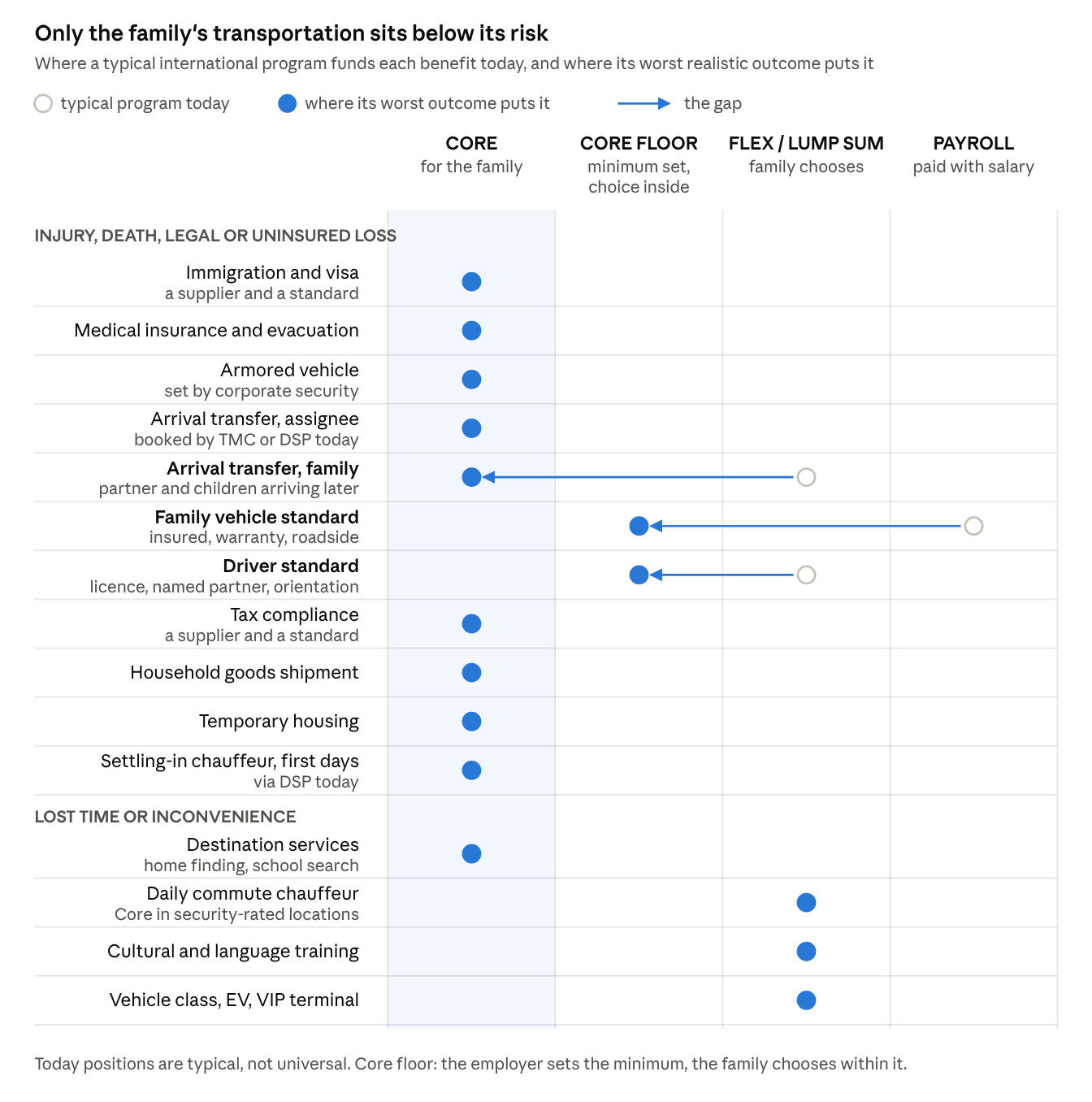
The three gaps are all about the family rather than the assignee. The partner and children arriving on a later flight are not collected. The family vehicle sits in a payroll allowance with no supplier and no standard. And nobody holds a driver standard: license validity, the partner named on the policy, an orientation to local conditions. A Core floor on the vehicle does not mean the employer picks the car. The family still chooses between the compact and the SUV. What the employer decides is that it is insured to a corporate minimum, under warranty, serviced, and carries roadside assistance and a replacement vehicle. The transportation budget has no cash value, because the moment it can be kept the incentive to go cheap is live.
Service by service: Core, floor or Flex
Two points deserve emphasis. First, the family vehicle is where most of the money sits and where most programs get it wrong, because it is funded through payroll and looks like compensation rather than a safety service. Second, the family’s arrival transfer costs a fraction of what it protects. It is the single most cost-effective duty of care measure in the relocation, and it is the one most often left to the taxi queue, because the travel policy only covered the employee.
None of this requires a bigger budget. It requires moving the transportation line from compensation to a managed service, the way housing and immigration were moved years ago. Eight rules do most of the work.
If the policy must allow outside sourcing, publish a minimum vehicle standard: maximum age and mileage, a four-star rating from the NCAP program that covers that market’s build, electronic stability control, curtain airbags, ISOFIX, liability cover at the corporate minimum, no peer-to-peer platforms. Then ask why the mobility team is being handed a compliance job that a vetted supplier would remove.
None of this makes the program less flexible where flexibility helps. The family still chooses the car, the color, the EV option and whether to keep a chauffeur after the first week. What they no longer choose is whether they are insured, whether the brakes work, whether the partner is licensed, and who is driving the children from the airport.
ExpatRide has handled assignee and family transportation since 2011, in 197 countries and territories. We are not against core-flex, and we are not a replacement for the RMC or the destination service provider. We work inside their programs every day, and the good ones work well.
What we are against is treating the family’s transportation as compensation. It is how children get to a school they have never seen, how a partner gets to a hospital in a city they cannot yet navigate, and how an employee gets to work in a country where they cannot yet read the signs. When that is funded through an allowance and left to hope, the employer has not given the family freedom. It has given them the risk, and kept the consequences.
If you run a mobility program, ask one question of your policy this week: if the partner was injured on the school run in a car bought with the allowance, would the policy show that you set a standard? If the answer is no, the fix is not more flexibility. It is a floor.
The quickest way to see where your current policy leaves the family exposed is the ExpatRide planning tool: six minutes, your assignment destinations mapped against road risk, and a transportation program outline you can take to your RMC and your security team, at no cost. If you would rather go through it together, write to CARS@ExpatRide.com.
Related: Corporate Billed Car Leasing, Relocation Transportation Services and the driving license rules by country.
Standards referred to: ISO 31030 (travel risk management) and ISO 39001 (road traffic safety management).