.svg)

The word relocation can be often seen as a cumbersome activity which is connected with changing locations for work, but also with personal and other reasons. However relocation isn’t just about packing boxes and moving to a new address. It is a life event that impacts individuals not only from emotional but also social, and cultural perspectives. And whether planned or rather unexpected, such event often disrupts long established routines and habits, forcing us to pause, reflect and establish new habits which will be giving structure to the life in the new location. That is why moving for an international assignment offers a unique opportunity. Not only for the assignee but for the whole Global Mobility industry and the environment specifically. And understanding the importance of this opportunity, represents an important moment for Global HR to influence behavior positively.
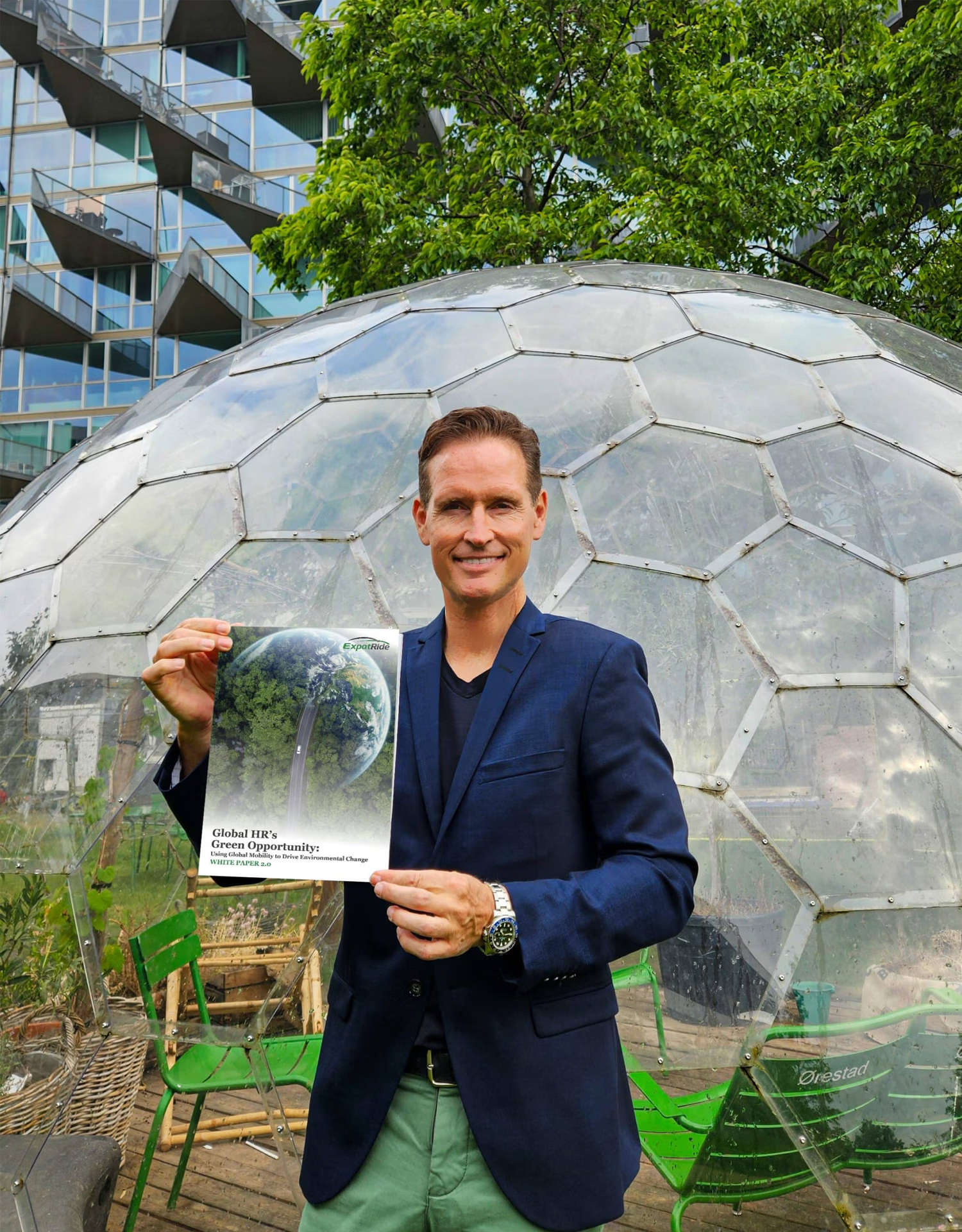
In the next few weeks, we would like to walk you through our findings we have gathered when writing our White Paper 2.0, Global HR’s Green Opportunity: Using Global Mobility to Drive Environmental Change. We hope to inspire you to challenge your conventional thinking, the way how you see relocation but also revisit your actions when guiding the assignees towards their new life in the new location. We believe that by aligning relocation policies with sustainable goals and providing robust support for assignees, companies in our industry can turn a move from a logistical challenge into a transformative opportunity, for individuals and the planet alike.
Life Events as a Trigger for Change
Whether being joyful milestones like marriage or the birth of a child, or unforeseen challenges like illness or natural disasters, these and other important life-changing events hold the power to reshape our perspectives, behaviors, and even long-term habits. They simply trigger a change. And despite a change might often feel daunting, it is one of the most profound forces that shape individuals and societies. The psychology of change examines how we humans react, adapt, and evolve in reaction to disruptions caused by the change. And understanding this process reveals not only the potential for personal transformation but also the power to inspire broader societal advancements. According to Professor Bas Verplanken, such disruptions can also be pivotal in forming sustainable habits and fostering environmentally conscious behavior. This idea of looking at our industry through a lense of “relocation being a trigger for a positive change” led us to cooperation with Professor Verplanken, asking him to take a close look at our industry, and, provide us with his perspective on Global Mobility as a window for potential habit change in relation to sustainability.
Why Change Can Be Transformative – The Habit Discontinutity Study by Prof. Verplanken
People are creatures of habit. And habits, together with routines, offer comfort, predictability and efficiency into our lives. This automaticity is the product of the frequent repetition and consistency of the behavior under the same circumstances. Breaking the habitual behaviors due to significant life events – in other words “habit discountinuity” – has been studied for years by Professor Bas Verplanken at the University of Bath. His research shows that in the ocurrence of major life events these disruptions create an opportunity window, where individuals are more receptive to adopt new behaviors or mindsets. For example, moving to a new city may encourage someone to explore cultural diversity, form new friendships, or adopt sustainable practices like walking more instead of driving. These shifts, while seemingly small, can accumulate over time and lead to profound personal growth.
The new habit formation reinforcement
“Habits exist because they serve us in some way. An important aspect of habits is that they require some form of reinforcement. This applies during the formation of habits particularly.” Professor Verplanken
These reinforcements can have many forms, from monetary, convenience, or even pleasure. Sometimes, the fact, that our actions can be seen as contributing to a good cause can act as a reinforcement for that behavior. A habit change is more frequently the result of changing the context in which we live and operate rather than changing our attitudes. So, when it comes to nudging employees to make greener choices, rather than dedicating too much effort to change people’s attitudes, it would be better to focus on the context and how altering the environmental cues triggers and supports the desired behavior.
The study
The habit discontinuity “phenomenon” has been studied by Professor Verplanken and his team in a controlled study with 800 households in the UK, where they tested circumstances and interventions that would promote sustainable behaviors in the context of a household relocation as a major change. Participants were divided into two groups, 400 households which relocated recently and 400 household which did not. Participants were asked how often they had performed 25 sustainable behaviors related to water consumption, waste management, transport and energy usage during the last year. These were presented again eight weeks later with reference to the same time frame. His study brought interesting conclusions that can serve as important insights for Global Mobility.
💡 The interventions for taking more sustainable actions were more effective in the households, that had moved recently. The effect was even more noticeable in the households who moved within the past 3 months.
These findings suggest that there is a critical window during which a discontinuity, such as moving house, provides an enhanced opportunity for behavior change. In this window, the changed circumstances forced people to “pause and think” and re-evaluate the options and choices they make. Moreover, people going through the process of change are more open to considering alternatives that they had not considered before.
The outcome of this academic study presents a solid base for understanding the psychology of change and what impact the right interventions can have on an individual’s behavior and habits. However, we were curious to know what would happen if we were to apply the same principles in a commercial environment. Could his results be duplicated in the real world and if so, what would be the resulting impact on the environment? We believe that leveraging a move to encourage employees to adopt sustainable habits can have an even greater impact than that discovered in the research.

Conclusion
Change, while challenging, holds immense potential for fostering growth, both individually and collectively. By understanding and embracing the psychology of change, the Global Mobility professionals can unlock new possibilities within the industry, while addressing pressing climate change challenges. As we are at a heart of relocating people, Global Mobility industry has a unique position to help catalyze a positive change by promoting and supporting sustainable behaviors on a long-term assignments. And understanding that the opportunity window happens now – within a first few months of relocation. If companies can design and adjust their ESG policies and interventions and time them more effectively to align with the natural human inclination to adapt, they will make it easier for assignees to make sustainable choices without adding unnecessary burdens to the process.
Sources:
1. White Paper 2.0 – Global HR’s Green Opportunity: Using Global Mobility to Drive Environmental Change
Image credits:
1. Photo by Wes Hicks on Unsplash
2. Photo by Adrien Ledoux on Unsplash



.svg)


